The Christian Heritage of Kosovo and Metohija at King’s College
On 10 May 2015 at 2pm in the Bishop Nikolaj Centre, next to the St Sava's Church in London, and that evening at 7pm in King's College Chapel in London, there were presentations of the monograph, in English, 'The Christian Heritage of Kosovo and Metohija: The Historical and Spiritual Heartland of the Serbian People' (an expanded edition of the book 'The Endowments of Kosovo) co-published by Sebastian Press, the publishing house of the of the Western Diocese of the Serbian Orthodox Church in America, with the Institute of Balkan Studies, Serbian Academy of Science and Art (SANU), and the Faculty of Orthodox Theology, University of Belgrade.
The monograph had already been presented across America, from east to west, to much acclaim as an accomplished publishing undertaking, which between the covers of the book of 1008 pages, captures concisely the most important social and historical movements on the territory of Kosovo and Metohija, which for Orthodox Serbs represents its spiritual and national cradle and where the Holy Trinity and His believers made their pledge.
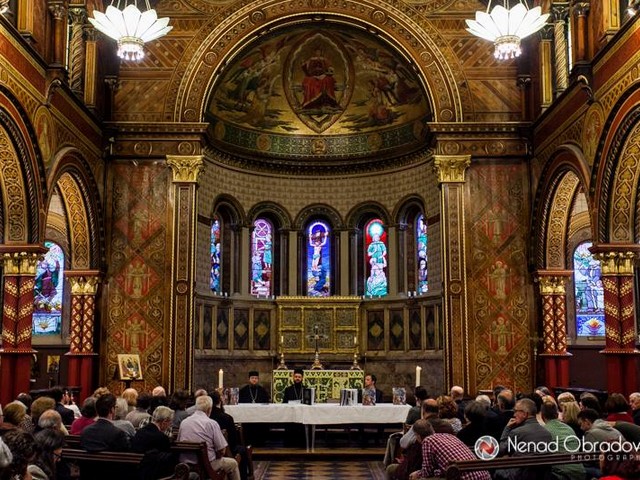
His Grace Bishop Dr Maxim (Vasilijevic), of the Western American Diocese and Abbot Sava (Janic), Decani Monastery, spoke to an audience of over one hundred interested people, in the magnificent and recently refurbished Chapel of the Archangel, in the prestigious King's College, University of London.
His Grace Bishop Maxim gave a brief introduction about the contents of the book, stressing that this monograph was a living testament of the historical endeavours of the Serbian Orthodox Church to create an outstanding spiritual and material culture, and to preserve its centuries old monuments and the Christian heritage of Kosovo and Metohija. He mentioned that the work was the fruit of the labours of more than ten specialist authors and in particular the historian Professor Dusan Batakovic, Director Balkan Institute, SANU. This monumental monograph, in scientific, cultural, artistic and historical terms, satisfies the highest standards in the best way possible, through numerous incontrovertible historical facts and rich illustrated material documents the historical and spiritual identity of the Serbian people in Kosovo and Metohija. The book is not a political, but rather a historical document and a tribute to Kosovo and Metohija and its nearly one thousand year old history.
Father Sava asserted that the spiritual, cultural and artistic wealth of Kosovo and Metohija ranked as one of the most important achievements of Christian civilisation (he mentioned that there were 1400 churches and monasteries and tens of important shrines from the 12th to 14th centuary). Unfortunately, rather than being recognised as part of the world heritage, these orthodox and Serbian monuments (apart from a few) face the danger of demolition and even annihilation. Because of this the Serbian Orthodox Church is extremely worried about the fate of our people in Kosovo and their religious monuments (150 religious monuments were destroyed between 1999 – 2003 and a further 35 in the pogrom of 2004.
Highlighting concrete examples of ordeals/suffering from the current Kosovo drama, Father Sava called for basic human rights and religious freedom to be respected. In particular he drew attention to the inability of Serbian refugees to return or for religious monuments and cemeteries to be visited. He reminded the audience of that the remaining Serbs were indispensible and of their need for protection, the freedom of movement, the right to work, the right to own property and all else. Father Sava did not fail to draw to attention to the positive aspects of life in Kosovo, signified above all by the re-opening of the Seminary in Prizren, the results of the great efforts of the professors and pupils, which also point to a better future for the Serbian people in Kosovo. He also said that the visits of numerous pilgrims to the Orthodox Christian shrines gave hope for the restoration of monasteries and churches, and they contribute to the mission of the church, which has a crucial impact on the trust between peoples and races, and in this way on the restoration of life, in the widest possible meaning of the word.
Both speakers called for an end of barbarian destruction and desecration of churches and cemeteries in Kosovo and that there should be protection for working monasteries and churches which are of indescribable national, humanitarian and spiritual-cultural value. Similarly it was stressed that its property should be returned to the Serbian Orthodox Church, and that priests in Kosovo should be allowed to carry out their pastoral and spiritual work without interference.
The book is in hard back and colour, with 1008 pages, illustrated with over 900 high quality reproductions of all of the important historical individuals, towns, monasteries, churches, frescos, icons and artistic works of the highest nature, and in particular the book features the Serbian heritage under the protection of UNESCO. Apart from this, the monograph features the work of our leading historians, theologians, publicists, artists and more importantly: the translation of historical documents and charters and various communiqués and announcements and to our tragic fate in the Kosovo of today. Alongside national importance, this monograph is of importance to Christians across the world, to whom the Serbian and Christian character of our Holy land, is unknown or little known.
Photographs from the Kings College event are available in the GALERY.