Why we celebrate Christ`s Resurrection (Easter) when we do

This year (2017) we the Orthodox Christians celebrate Christ`s Resurrection (Easter) on the same date as all the other Nonorthodox Christians namely on 16th. April . Having this in mind we will outline the basic principles as to how this date is derived for a particular year and why it happens that the orthodox and nonorthodox celebrate mostly on different dates and it is only some years the dates coincide.

Easter is the most important Christian feast. It is a feast which is always celebrated on the same day (Sunday) but the actual date varies. Originally the Christians in Judea and converts from Judaism did celebrate Easter with the Jewish feast of Passover on 14th. day of the Jewish month Nissan which ever day of the week this feast happens to be while the res Christians from Roman and Greek background celebrated the feast of Easter on the first Sunday after that date. The celebration of Passover lasts 7 days and the Jews celebrate it in memory of exodus from the slavery in Egypt and the crossing of the Red Sea. Easter is referred to in in liturgical songs of the Orthodox Church as new Pasha because Christs Resurrection represents the passing from death into life. That is why Greeks and other orthodox use the word Pasha instead of Easter.

In order for all Christians to celebrate Christ`s Resurrection on the same day at the First council which took place in Nicaea in the year 325 it was decided that all Christians will celebrate the Resurrection of Christ on the same day and that is to be on the first Sunday after the full moon after the spring equinox and after the Jewish Passover.

The Annunciation

БлаговестиWhen the most holy Virgin had lived and served in the Temple at Jerusalem for eleven years, and was by then fourteen years old when, that is, she was entering on her fifteenth year - the priests informed her that, according to the Law, she could no longer remain in the Temple but must be betrothed and marry. But, to the great surprise of all the priests, the most holy Virgin replied that she had dedicated herself to God and wished to a maiden remain till death and enter into wedlock with no-one.
Then, by God's providence and under His inspiration, Zacharias, the high priest and father of the Forerunner, in consultation with the other priests, chose twelve unmarried men from the tribe of David so that they might entrust the Virgin Mary to one of them to preserve her virginity and care for her. She was thus entrusted to Joseph, an old man from Nazareth and a kinsman of hers. In his house, the most holy Virgin continued to live in the same manner as in the Temple of Solomon, passing her time in the reading of the sacred Scriptures, in prayer, in pondering on the works of God, in fasting and in handwork. She scarcely ever left the house, nor took an interest in worldly matters or events. She generally conversed very little with anyone, and never without a particular need. She was intimate only with the two daughters of Joseph. But when the time prophesied by the Prophet Daniel had come and when God was pleased to fulfil the promise made to Adam when He drove him out of Paradise, and to the prophets, the mighty Archangel Gabriel appeared in the chamber of the most holy Virgin, at the precise moment (as some priestly writers have related) that she was holding open on her lap the book of the Prophet Isaiah and pondering on his great prophecy: 'Behold, a virgin shall conceive and bear a son'. Gabriel appeared to her in angelic light and said to her: 'Rejoice, thou that art highly favoured, the Lord is with thee!', and so forth, just as is related in the Gospel of the divine Luke. With this angelic greeting and the descent of the Holy Spirit, the salvation of mankind and the renewal of creation were set in motion. The Archangel turned the first page of the story of the New Testament with the word 'Rejoice!', to show by this the joy that the New Testament signifies for mankind and for all things created. And therefore the Annunciation is looked upon as a joyous, as well as a great, feast.

The Gospel on fasting

Matthew 6:14-21

To not give in to the enemy—that is the main rule for those who are fighting a war. An army commander warns every soldier ahead of time about the threat of enemy subterfuge, so that they would not be deceived and taken captive. A soldier left alone, hungry, shivering and without warm clothing undergoes a strong temptation to give himself up to the enemy. The cunning adversary will take advantage of his situation with all possible means. He will deprive himself of bread in order to throw a bit of it at the soldier and give him the impression that he has an abundance of food. He’ll remain dressed in rags, half-naked and freezing, just to throw him some a piece of clothing to make him think that he himself is well dressed and rich. He will start throwing letters boasting of his already assured victory and deceive the wretched soldier, saying that many of his comrades at arms have already given up left and right, that his general has been killed, or his king is pleading for peace! He’ll then promise a speedy return to home and hearth, and rank, and money, and everything that a man in extreme need can see only in his dreams. The commander describes all of these enemy tricks and traps to the soldiers, warning them not to believe any of it but to hold their position, not give up, and remain loyal to their standard to the death.

Synaxis of St John the Baptist

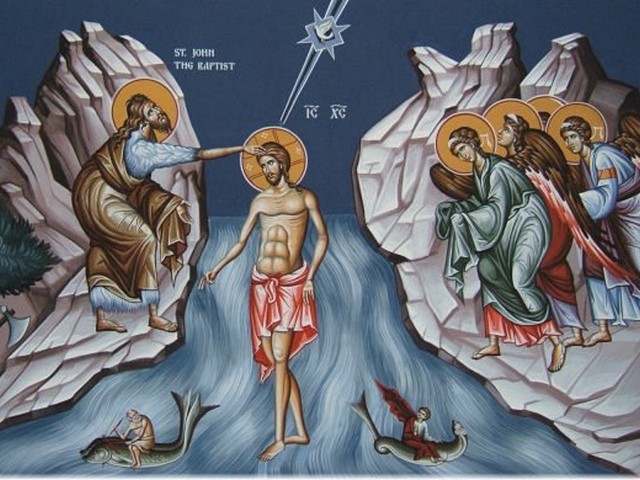
In the Orthodox Church it is customary, on the day following the Great Feasts of the Lord and the Mother of God, to remember those saints who participated directly in the sacred event. So, on the day following the Theophany of the Lord, the Church honors the one who participated directly in the Baptism of Christ, placing his own hand upon the head of the Savior.

St John, the holy Forerunner and Baptist of the Lord, whom the Lord called the greatest of the prophets, concludes the history of the Old Testament and opens the era of the New Testament. The holy Prophet John bore witness to the Only-Begotten Son of God, incarnate in the flesh. St John was accounted worthy to baptize Him in the waters of the Jordan, and he was a witness of the Theophany of the Most Holy Trinity on the day of the Savior's Baptism.

The holy Prophet John was related to the Lord on His mother's side, the son of the Priest Zachariah and Righteous Elizabeth. The holy Forerunner, John, was born six months before Christ. The Archangel Gabriel announced his birth in the Temple at Jerusalem, revealing to Zachariah that a son was to be born to him.

Through the prayers offered beforehand, the child was filled with the Holy Spirit. St John prepared himself in the wilds of the desert for his great service by a strict life, by fasting, prayer and sympathy for the fate of God's people.

The Theophany

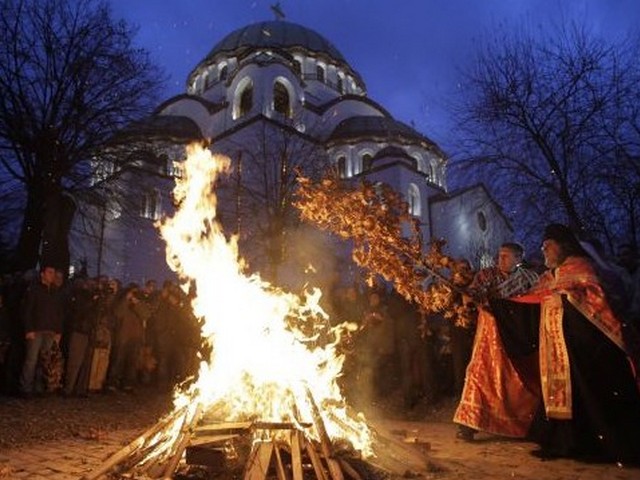
Theophany is the Feast which reveals the Most Holy Trinity to the world through the Baptism of the Lord (Mt.3:13-17; Mark 1:9-11; Luke 3:21-22). God the Father spoke from Heaven about the Son, the Son was baptized by the St John the Forerunner, and the Holy Spirit descended upon the Son in the form of a dove. From ancient times this Feast was called the Day of Illumination and the Feast of Lights, since God is Light and has appeared to illumine "those who sat in darkness," and "in the region of the shadow of death" (Mt.4:16), and to save the fallen race of mankind by grace.

In the ancient Church it was the custom to baptize catechumens at the Vespers of Theophany, so that Baptism also is revealed as the spiritual illumination of mankind.

Patriarchal Nativity Encyclical 2016

The Serbian Orthodox Church to her spiritual children at Christmas, 2016

+IRINEJ

By the Grace of God

Orthodox Archbishop of Pec, Metropolitan of Belgrade Karlovci and Serbian Patriarch, with all the Hierarchs of the Serbian Orthodox Church, to all the clergy, monastics, and all the sons and daughters of our Holy Church: grace, mercy, and peace from God the Father and our Lord Jesus Christ and the Holy Spirit, with the joyous Christmas greeting:

Peace from God! Christ is Born!

Velika sala baner

Hall rental

Brookwood-banner

Brookwood

spc-london-baner-vesti

News and events

Contact

St.Sava church adress:
89 Lancaster Road
London
W11 1QQ
Telephone: 020 7727 8367
E-mail: crkva@spclondon.org.uk


Donations

paypal-donate

If you want to make a payment directly to the account of the SOC, please go to DIRECT PAYMENTS page.